

Container Lashing Robots Market Benefits from Rising Focus on Operational Safety and Productivity
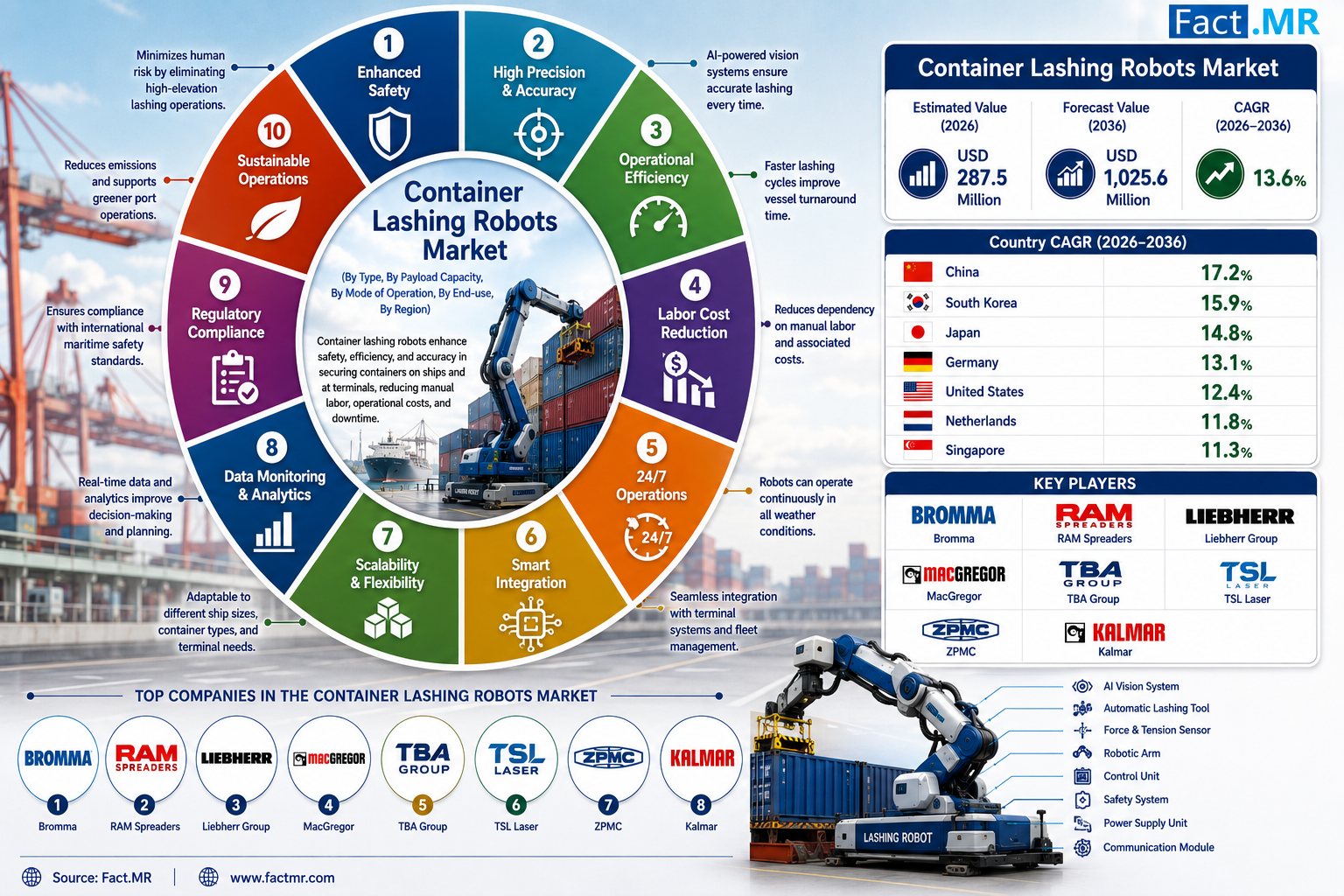
Executive Summary
The global Container Lashing Robots Market is entering a pivotal stage of commercialization as ports increasingly automate vessel-side operations to improve productivity and worker safety. According to Fact.MR, the market is expected to grow from USD 35 million in 2026 to USD 413.2 million by 2036, registering a robust 28.0% CAGR during the forecast period. The industry was valued at USD 27.3 million in 2025 and is projected to generate an absolute opportunity of USD 378.2 million over the next decade.
Growth is being driven by the expansion of automated container terminals, increasing deployment of robotic twistlock handling systems, and rising pressure on ports to reduce hazardous manual operations around quay cranes. As shipping lines continue operating larger vessels and global container throughput rises, terminal operators are investing in robotics capable of improving vessel turnaround while minimizing labor-intensive deck activities.
Although full-scale robotic lashing remains in its early stages, commercial deployment of robotic twistlock handling systems, AI-powered inspection technologies, vision-guided robotic arms, and remote-operated equipment is steadily reshaping port operations. The industry is evolving toward safer, smarter, and more connected container terminals where robotics complements existing automation infrastructure rather than replacing it entirely.
Get detailed market forecasts, competitive benchmarking, and pricing trends: https://www.factmr.com/connectus/sample?flag=S&rep_id=15472
Market Overview
Container lashing robots are specialized robotic systems designed to automate twistlock handling, lashing support, safety inspections, and other container securing activities performed during vessel loading and unloading. Traditionally, these tasks have required workers to operate in hazardous environments alongside heavy cranes, suspended containers, and moving cargo.
Fact.MR projects the market to expand nearly 12 times between 2026 and 2036 as container terminals modernize operations and address increasing labor safety requirements. Rather than pursuing complete onboard automation immediately, most ports are adopting incremental robotic solutions that integrate seamlessly with existing quay crane workflows.
The commercial focus has shifted toward automating repetitive, standardized tasks—particularly twistlock removal and replacement—which provide measurable productivity improvements while reducing worker exposure to dangerous operating environments.
Key Growth Drivers
Several long-term trends are accelerating demand for container lashing robots worldwide.
Rapid expansion of automated terminals has exposed container lashing as one of the last major manual operations within otherwise highly automated port environments. While cranes, yard vehicles, and terminal management systems have become increasingly autonomous, twistlock handling continues to depend heavily on manual labor.
Worker safety has emerged as another significant market catalyst. Port operators are seeking technologies capable of reducing employee exposure to suspended loads, repetitive physical strain, and congested deck operations. Robotic handling systems offer an effective pathway toward achieving stricter workplace safety objectives without disrupting terminal productivity.
The deployment of mega-container vessels further strengthens market demand. Larger ships require significantly higher container volumes to be processed within increasingly compressed berth schedules. Robotic systems capable of shortening twistlock handling time directly contribute to faster vessel turnaround and improved berth utilization.
Technology and Innovation Trends
Technology development within the Container Lashing Robots Market is centered on practical automation rather than fully autonomous vessel operations.
Robot arms are expected to account for 37% of technology adoption in 2026 due to their precision in handling twistlocks under varying operating conditions. Vision-guided robotics, artificial intelligence, remote operation platforms, and advanced safety sensors are becoming essential components of next-generation lashing systems.
AI-powered computer vision allows robots to accurately identify twistlock positions while monitoring safe operating zones around personnel and equipment. Remote operation models enable human supervision from secure control rooms, reducing operational risks without eliminating operator oversight.
Manufacturers are also prioritizing ruggedized robotic platforms capable of operating reliably under harsh marine conditions including salt spray, vibration, heavy rainfall, and continuous cargo movement.
Market Challenges and Restraints
Despite strong growth prospects, commercialization challenges remain.
The largest obstacle is the relatively low maturity of fully automated lashing technology. While robotic twistlock handling has demonstrated promising results, complete deck automation remains technically complex because vessel configurations, terminal layouts, and twistlock designs vary considerably across shipping fleets.
Reliability under real-world operating conditions represents another critical challenge. Port environments expose robotic equipment to harsh weather, vibration, corrosion, dust, and continuous mechanical stress. Terminal operators require exceptionally high uptime before committing to large-scale deployment.
Industry standardization also remains limited. Different vessel designs, operational procedures, and labor practices complicate system integration across global ports. In many regions, labor regulations and established stevedoring workflows encourage gradual adoption through semi-automatic or remotely supervised solutions rather than immediate full automation.
Segment Analysis
Market segmentation highlights where commercial adoption is gaining the strongest momentum.
By automation level, Robotic Units are projected to capture 38% market share in 2026 as they provide the most practical transition between manual operations and future autonomous terminals.
By operation, Twistlock Handling dominates with 42% share owing to its standardized workflow and immediate productivity benefits. Compared with full lashing automation, twistlock handling offers faster commercialization and easier integration into existing terminal processes.
By terminal type, Automated Terminals account for 34% share as they already possess sophisticated control systems capable of supporting robotic equipment.
By technology, Robot Arms lead with 37% market share, driven by growing demand for accurate manipulation, vision-guided positioning, and intelligent handling systems.
From the buyer perspective, Terminal Operators represent the largest customer group with 44% share, reflecting their direct responsibility for quay productivity, worker safety, and vessel turnaround efficiency.
Regional Analysis
Asia continues to lead commercialization of container lashing robotics as governments and terminal operators accelerate investment in smart port infrastructure.
Singapore is projected to achieve the fastest growth globally with a 30.8% CAGR through 2036. Its advanced automated terminal ecosystem and emphasis on safety-led quay operations create ideal conditions for early deployment of robotic twistlock systems.
The Netherlands follows with 29.6% CAGR, supported by modernization of major transshipment hubs and growing demand for automated handling solutions serving mega-vessel berths.
China, forecast to expand at 28.7% CAGR, benefits from extensive port automation initiatives and large-scale equipment manufacturing capabilities led by domestic suppliers.
Germany is expected to record 27.4% CAGR, driven by engineering-focused terminal upgrades and increasing investment in remote-operated safety technologies.
Meanwhile, the United States is forecast to grow at 26.2% CAGR as ports gradually introduce robotic systems designed to improve worker safety while maintaining operational flexibility.
Competitive Landscape
Competition remains concentrated among port automation specialists, robotic equipment manufacturers, and container handling technology providers.
Companies are competing primarily through robotic reliability, integration capabilities, intelligent sensing technologies, and compatibility with existing quay operations. Rather than developing entirely autonomous terminals, vendors are focusing on modular solutions capable of solving immediate operational challenges.
Technology readiness, uptime performance, remote diagnostics, and adaptability to multiple twistlock configurations will increasingly determine competitive positioning over the next decade.
Leading Companies Analysis
Key participants shaping the Container Lashing Robots Market include RAM Spreaders, MacGregor, Bromma/Kalmar, ZPMC, and ABB Ports/ABB Robotics.
RAM Spreaders has strengthened its position through its PinSmart automated twistlock handling solution, while MacGregor continues expanding automatic twistlock technologies for next-generation container vessels.
ZPMC leverages its extensive presence in automated terminal equipment to support robotic integration initiatives, whereas ABB contributes advanced robotics, AI platforms, machine vision, and automation technologies that complement robotic lashing solutions. Bromma/Kalmar continues enhancing spreader technologies capable of supporting future robotic workflows.
Investment and Strategic Developments
Recent industry activity demonstrates growing confidence in robotic container securing technologies.
MacGregor secured orders for fully automatic twistlock systems supporting next-generation container ships, while RAM Spreaders continues advancing commercial deployment of quay-crane-mounted robotic twistlock handling equipment.
ABB has expanded AI-driven automation capabilities designed specifically for ports, enabling safer and more productive terminal operations through intelligent robotics and machine vision. These investments indicate that the industry is moving steadily from pilot demonstrations toward commercial deployment.
Future Outlook
The next decade is expected to transform container securing operations from labor-intensive processes into digitally connected robotic workflows. Initially, adoption will focus on robotic twistlock handling, safety inspection, and remote-operated assistance before gradually expanding toward broader vessel-side automation.
As AI, robotics, sensor technologies, and automated terminal infrastructure continue advancing, container lashing robots are likely to become standard components of high-throughput container terminals worldwide.
Conclusion
The Container Lashing Robots Market is transitioning from experimental automation toward practical commercial implementation. Strong growth fundamentals—including a projected 28.0% CAGR, increasing investments in smart ports, rising safety requirements, and growing demand for faster vessel turnaround—position the industry for sustained expansion through 2036.
Although technical complexity, environmental reliability, and workflow standardization remain ongoing challenges, advances in robotic manipulation, AI-powered vision systems, and remote operation technologies are steadily improving commercial viability. As container terminals continue pursuing end-to-end automation, robotic lashing solutions are expected to play an increasingly important role in creating safer, more efficient, and highly productive global port operations.
Related Report
Global Big Data Analytics in Healthcare Market Forecast: North America Leads Digital Transformation with IBM, Oracle & Microsoft https://www.openpr.com/news/4448255/global-big-data-analytics-in-healthcare-market-forecast-north
Global Tilapia Market Outlook: Asia-Pacific Leads Production with China Dominance and Companies like Thai Union & Charoen Pokphand https://www.openpr.com/news/4448273/global-tilapia-market-outlook-asia-pacific-leads-production
Global Air Springs Market Forecast: Europe Leads Automotive Innovation with Continental AG, Bridgestone & Firestone https://www.openpr.com/news/4448294/global-air-springs-market-forecast-europe-leads-automotive
Global PBT Market Outlook: Asia-Pacific Dominates Engineering Plastics with BASF, Celanese & Toray Industries https://www.openpr.com/news/4448334/global-pbt-market-outlook-asia-pacific-dominates-engineering
Contact Us
11140 Rockville Pike, Suite 400, Rockville,
MD 20852, United States
Tel: +1 (628) 251-1583 | sales@factmr.com
About Us
Fact.MR is a global market research and consulting firm, trusted by Fortune 500 companies and emerging businesses for reliable insights and strategic intelligence. With a presence across the U.S., UK, India, and Dubai, we deliver data-driven research and tailored consulting solutions across 30+ industries and 1,000+ markets. Backed by deep expertise and advanced analytics, Fact.MR helps organizations uncover opportunities, reduce risks, and make informed decisions for sustainable growth.

 English
 Arabic
 French
 Spanish
 Portuguese
 Deutsch
 Turkish
 Dutch
Dutch
 Italiano
 Russian
 Romaian
 Portuguese (Brazil)
 Greek
Greek
 日本語
日本語
 한국어
한국어
 繁体中文
繁体中文