

Air-Launched Effects (ALE) Market Accelerates on Growing Demand for Intelligent Airborne Defense Solutions
Executive Summary
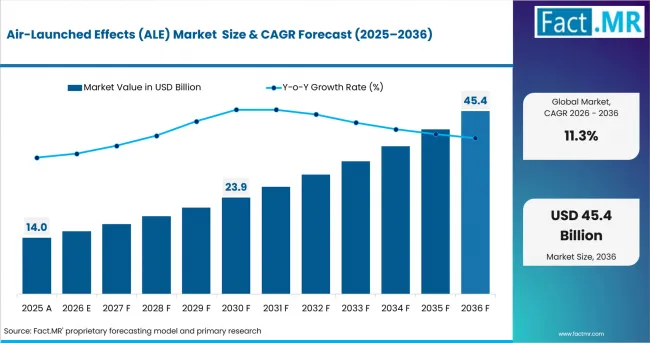
The global Air-Launched Effects (ALE) Market is entering a new era of defense modernization as armed forces increasingly prioritize autonomous combat systems, collaborative combat aircraft, and network-centric battlefield operations. According to Fact.MR, the market is projected to expand from USD 15.6 billion in 2026 to USD 45.4 billion by 2036, registering a robust 11.3% CAGR over the forecast period. The industry is expected to generate an absolute dollar opportunity of USD 29.8 billion, reflecting sustained investments in next-generation airborne capabilities.
Air-Launched Effects have evolved beyond traditional expendable drones into highly sophisticated platforms capable of intelligence, surveillance, reconnaissance (ISR), electronic warfare (EW), communications relay, decoy operations, and precision-strike missions. Their integration into manned-unmanned teaming (MUM-T) architectures enables military forces to extend operational reach, enhance battlefield awareness, and reduce risks to crewed aircraft operating in highly contested environments.
Rapid advances in artificial intelligence, autonomous navigation, secure communications, swarm technologies, and collaborative mission systems are accelerating deployment across major defense programs worldwide. While procurement complexity, interoperability challenges, and export regulations continue to influence market adoption, growing defense modernization initiatives across North America, Europe, and Asia-Pacific position the ALE market for sustained long-term expansion.
Get detailed market forecasts, competitive benchmarking, and pricing trends: https://www.factmr.com/connectus/sample?flag=S&rep_id=15177
Market Overview
Modern warfare is rapidly transitioning toward distributed, autonomous, and data-driven operations. Defense organizations are increasingly investing in systems capable of extending mission effectiveness without exposing high-value manned assets to hostile environments. Air-Launched Effects have emerged as one of the most strategically important technologies supporting this transformation.
Fact.MR estimates that the Air-Launched Effects Market will increase from USD 15.6 billion in 2026 to approximately USD 45.4 billion by 2036, representing an impressive 11.3% CAGR. The market's projected 2.9X growth multiple underscores increasing military reliance on autonomous airborne systems capable of performing multiple mission profiles from reconnaissance and electronic attack to communications relay and precision engagement.
Unlike conventional unmanned aircraft, ALE platforms are specifically designed for deployment from fixed-wing aircraft, helicopters, and unmanned aerial vehicles, providing force multiplication while enhancing survivability across multi-domain operations.
Key Growth Drivers
Military modernization programs remain the primary catalyst for Air-Launched Effects adoption. Defense agencies worldwide are increasing investments in next-generation combat capabilities designed to improve operational flexibility while reducing battlefield risk.
Another significant driver is the growing implementation of Manned-Unmanned Teaming (MUM-T) concepts. Modern fighter aircraft and bombers increasingly deploy autonomous airborne effects capable of conducting reconnaissance, identifying targets, jamming enemy communications, and supporting precision strikes while allowing crewed aircraft to remain outside contested airspace.
The evolution of network-centric warfare is further accelerating demand. Modern battlefields require continuous intelligence sharing, secure communications, and coordinated autonomous decision-making. ALE systems support these requirements by acting as distributed sensors, communications nodes, and mission enablers across interconnected combat networks.
Growing geopolitical tensions and rising defense expenditures across NATO members, Asia-Pacific, and allied nations continue creating favorable conditions for long-term procurement of advanced airborne autonomous systems.
Technology & Innovation Trends
Technological innovation is fundamentally reshaping the Air-Launched Effects ecosystem.
Artificial Intelligence has become central to mission execution, enabling autonomous navigation, adaptive target recognition, threat prioritization, and collaborative mission planning with minimal operator intervention.
Swarm technologies represent another transformative development. Multiple ALE platforms can now coordinate missions collectively, overwhelming sophisticated air defense systems while improving battlefield resilience through distributed operations.
Electronic Warfare capabilities are experiencing particularly rapid advancement. Modern ALE platforms increasingly integrate electronic attack payloads capable of disrupting communications, degrading radar systems, and suppressing enemy air defenses during complex combat operations.
Advances in secure data links, edge computing, sensor fusion, autonomous mission software, and modular payload architectures are also expanding operational flexibility across intelligence gathering, reconnaissance, communications relay, decoy operations, and precision-strike missions.
Market Challenges & Restraints
Despite strong growth prospects, several challenges continue influencing market development.
Development costs remain substantial due to the complexity of integrating artificial intelligence, secure communications, advanced sensors, and electronic warfare capabilities into compact airborne platforms. High acquisition costs may limit adoption among nations with constrained defense budgets.
Interoperability presents another challenge. ALE systems must seamlessly integrate with existing aircraft, command-and-control networks, and military communications infrastructure while maintaining cybersecurity and operational resilience.
Strict defense procurement procedures, export regulations, technology transfer restrictions, and lengthy qualification processes can delay international commercialization and procurement schedules.
Electronic warfare resilience and secure communication protocols remain critical technical priorities as adversaries develop increasingly sophisticated countermeasures against autonomous battlefield systems.
Segment Analysis
Loitering Munitions dominate the market with 38.7% share in 2026, reflecting their unique ability to combine reconnaissance, target identification, and precision engagement within a single expendable platform. Growing procurement of autonomous strike systems continues strengthening this segment's leadership.
Among launch platforms, Fixed-Wing Aircraft account for 58.8% of market demand due to their extended operational range, multi-mission flexibility, and integration with advanced fighter aircraft, bombers, and collaborative combat aircraft programs.
Intelligence, Surveillance & Reconnaissance (ISR) represents the leading operational role with approximately 32.0% market share, driven by growing military requirements for persistent battlefield awareness, target acquisition, and real-time intelligence.
The Air Force remains the dominant end-user, accounting for approximately 46.0% of global demand. Investments in autonomous airborne capabilities, precision engagement, collaborative combat aircraft, and advanced mission systems continue driving procurement across air force organizations worldwide.
Meanwhile, Electronic Warfare is projected to be the fastest-growing product category throughout the forecast period as military organizations increasingly prioritize spectrum dominance, communications disruption, and suppression of enemy air defense capabilities.
Regional Analysis
North America continues leading the global Air-Launched Effects Market due to its extensive defense expenditure, mature aerospace industry, and early adoption of autonomous combat technologies.
The United States is expected to grow at 10.3% CAGR, supported by investments in collaborative combat aircraft, autonomous reconnaissance systems, electronic warfare platforms, and next-generation precision engagement programs.
Europe represents the second-largest regional market as NATO modernization initiatives, defense spending increases, and autonomous warfare programs accelerate procurement.
Within Europe, Italy is projected to register 12.5% CAGR, followed by France (12.4%) and Germany (11.1%), reflecting expanding investments in electronic warfare, airborne reconnaissance, and advanced autonomous defense technologies.
Asia-Pacific remains one of the fastest-growing regions due to increasing geopolitical tensions, indigenous defense innovation, and expanding military modernization initiatives.
South Korea leads global country-level growth with 13.5% CAGR, followed by China (12.2%) and Japan (10.8%), driven by investments in autonomous combat systems, indigenous unmanned technologies, and advanced military aviation capabilities.
Competitive Landscape
The Air-Launched Effects Market remains moderately consolidated, with leading aerospace and defense companies leveraging extensive expertise in autonomous systems, precision weapons, advanced sensors, and electronic warfare technologies.
Competition increasingly focuses on artificial intelligence integration, modular mission architectures, autonomous mission capability, electronic warfare effectiveness, secure communications, and rapid manufacturing scalability.
Defense contractors are strengthening strategic collaborations while expanding investments in collaborative combat aircraft programs, digital mission systems, and software-defined autonomous platforms to address evolving military requirements.
Leading Companies Analysis
Several global defense contractors continue driving innovation through investments in autonomous warfare technologies and advanced airborne mission systems.
Key industry participants include:
-
Lockheed Martin / Sikorsky
-
RTX Corporation / Raytheon
-
Northrop Grumman
-
Boeing
-
General Atomics Aeronautical Systems
-
Anduril Industries
-
AeroVironment
-
Leonardo
-
AEVEX Aerospace
-
Collins Aerospace
These companies continue expanding capabilities across loitering munitions, autonomous reconnaissance platforms, electronic warfare payloads, secure communications, collaborative combat systems, and AI-enabled mission software.
Investment & Strategic Developments
Industry investment continues accelerating as defense organizations prioritize autonomous combat capabilities.
Recent strategic developments include Anduril Industries' partnership with Rheinmetall to develop European variants of Barracuda and Fury autonomous air vehicles, continued advancement of the Barracuda-500 under the U.S. Air Force Enterprise Test Vehicle program, and successful flight testing of the Barracuda-100M supporting future U.S. Army high-speed autonomous missile initiatives.
These developments demonstrate increasing emphasis on scalable manufacturing, modular mission architectures, localized production, and collaborative defense innovation.
Future Outlook
The Air-Launched Effects Market is expected to remain one of the fastest-evolving segments within the global defense industry through 2036.
Future growth will be driven by artificial intelligence, autonomous mission execution, collaborative combat aircraft, multi-domain operations, electronic warfare modernization, and distributed battlefield networking. As defense organizations increasingly transition toward software-defined warfare and autonomous force multiplication, ALE platforms will become integral components of future air combat operations.
Manufacturers capable of delivering interoperable, AI-enabled, electronically resilient, and cost-effective autonomous airborne systems will be well positioned to capture expanding defense modernization opportunities across developed and emerging military markets.
Other Related Reports
Gaming Hardware Market https://www.openpr.com/news/4441491/global-gaming-hardware-market-outlook-2026-2034
Advanced Ceramics Market https://www.openpr.com/news/4441480/global-advanced-ceramics-market-outlook-2026-2036
Cannabigerol Market https://www.openpr.com/news/4441471/global-cannabigerol-cbg-market-outlook-2025-2035-north
Golf Cart Market https://www.openpr.com/news/4441447/global-golf-cart-market-outlook-2025-2035-north-america
Conclusion
The Air-Launched Effects (ALE) Market is rapidly evolving into a cornerstone of next-generation military operations. With the market forecast to grow from USD 15.6 billion in 2026 to USD 45.4 billion by 2036, achieving an 11.3% CAGR, autonomous airborne systems are becoming essential for intelligence gathering, precision engagement, electronic warfare, and collaborative combat missions. Continued advancements in artificial intelligence, swarm technologies, secure communications, and manned-unmanned teaming will reinforce market momentum. While procurement complexity and interoperability remain key challenges, sustained defense modernization initiatives and increasing investments in autonomous warfare capabilities will position Air-Launched Effects as a critical enabler of future multi-domain combat operations.
Contact Us -
11140 Rockville Pike, Suite 400, Rockville,
MD 20852, United States
Tel: +1 (628) 251-1583 | sales@factmr.com
Fact.MR is a global market research and consulting firm, trusted by Fortune 500 companies and emerging businesses for reliable insights and strategic intelligence. With a presence across the U.S., UK, India, and Dubai, we deliver data-driven research and tailored consulting solutions across 30+ industries and 1,000+ markets. Backed by deep expertise and advanced analytics, Fact.MR helps organizations uncover opportunities, reduce risks, and make informed decisions for sustainable growth.

 English
 Arabic
 French
 Portuguese
 Deutsch
 Turkish
 Dutch
Dutch
 Italiano
 Russian
 Romaian
 Portuguese (Brazil)
 Greek
Greek
 简体中文
简体中文
 日本語
日本語
 한국어
한국어
 繁体中文
繁体中文